Table of Contents
ToggleUltimate AC vs DC vs BLDC Fan Guide 2026 – Energy Saving & Quiet Options Worldwide
With rising electricity prices globally, choosing the right AC vs DC vs BLDC Fan can save significant energy and money. Whether for your home, office, or solar-powered system, understanding each fan type is essential in 2026.
This guide explains how AC vs DC vs BLDC Fans work, their advantages, disadvantages, energy efficiency, noise levels, and which fan is best for ceiling and pedestal use worldwide.
1️⃣ What Is an AC vs DC vs BLDC Fan?
AC vs DC vs BLDC Fan differences begin with their motor technology:
AC Fan: Runs directly on household alternating current (110–120V USA, 220–240V global).
DC Fan: Converts AC to DC using internal electronics for smoother operation.
BLDC Fan: Brushless DC fan uses permanent magnets and electronic controllers for maximum efficiency and lifespan.
2️⃣ How an AC vs DC vs BLDC Fan Works
AC Fans
Uses an induction motor powered by AC.
Blades rotate via a magnetic field created by alternating current.
Simple, durable, strong airflow.
DC Fans
Electronic commutation converts AC to DC.
Smoother rotation, lower energy usage.
Compatible with inverter and solar systems.
BLDC Fans
Brushless motor with sensors and controllers.
Extremely low power consumption.
Ideal for smart homes and long-term energy savings.
3️⃣ Advantages & Disadvantages of AC vs DC vs BLDC Fan
| Feature | AC Fan | DC Fan | BLDC Fan |
|---|---|---|---|
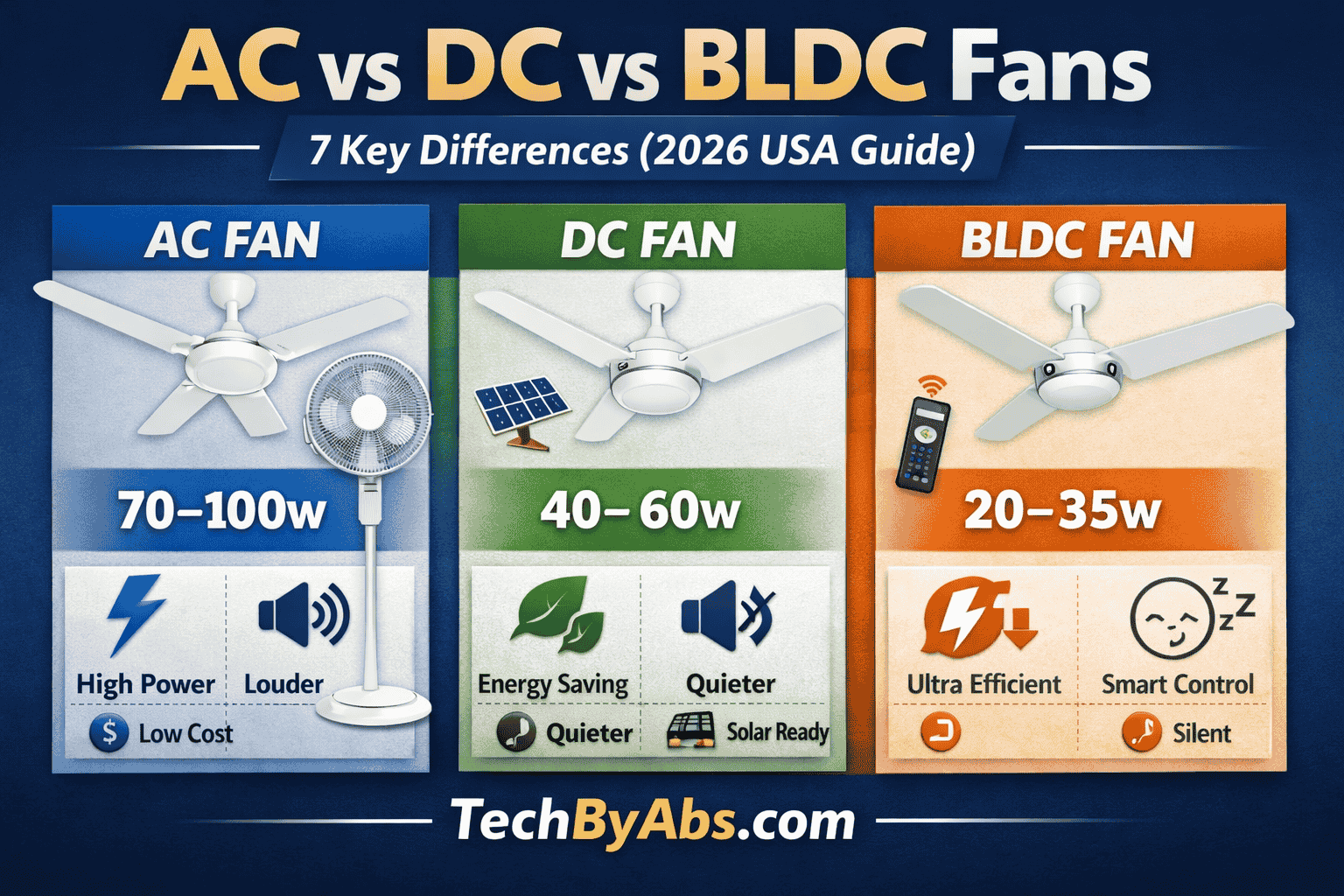
| Power Usage | 70–100W | 40–60W | 20–35W |
| Noise | Medium | Low | Very Low |
| Lifespan | Standard | Good | Excellent |
| Energy Saving | Low | Moderate | High |
| Smart Features | Limited | Basic | Advanced |
| Solar/Inverter | Poor | Good | Excellent |
| Cost | Low | Moderate | Higher |
Quick Insight:
AC vs DC vs BLDC Fan power differences are huge. BLDC fans consume up to 65% less electricity than AC fans.
4️⃣ Energy Consumption & Cost (Global Perspective)
Using an AC vs DC vs BLDC Fan 8 hours daily:
AC Fan: ~25–30 kWh/month
DC Fan: ~12–18 kWh/month
BLDC Fan: ~6–10 kWh/month
High electricity cost countries (USA, UK, Europe, Australia, Middle East) benefit most from BLDC fans.
5️⃣ Best AC vs DC vs BLDC Fan for Your Home
🏠 Bedrooms & Living Rooms
BLDC Fan: Silent, energy-efficient, smart features
🏢 Offices & Study Rooms
DC or BLDC Fan: Smooth operation, low noise
🔧 Workshop & Garage
AC Fan: Strong airflow, durable
☀ Solar-Powered Homes
DC or BLDC Fan: Low power consumption, inverter compatible
6️⃣ Recommended Global Brands Using AC vs DC vs BLDC Fan
Hunter Fan Company
Panasonic
Havells
Orient Electric
These companies now produce energy-efficient DC and BLDC fans for global markets.
7️⃣ AC vs DC vs BLDC Fan Affiliate Comparison
Using AC vs DC vs BLDC Fan affiliate links can help monetize energy-conscious buyers worldwide.
8️⃣ Frequently Asked Questions (FAQ)
❓ Is a BLDC fan worth buying in 2026?
Yes. BLDC fans use only 20–35W, saving up to 65% electricity over AC fans.
❓ Which fan is best for solar or inverter use?
BLDC fans are ideal. DC fans are also compatible.
❓ Are DC fans quieter than AC fans?
Yes. DC and BLDC fans operate smoothly with minimal vibration.
❓ What is the lowest watt AC vs DC vs BLDC Fan?
Most BLDC fans consume only 20–35 watts, the lowest among all fan types.
9️⃣ Final Verdict
For long-term energy savings, quiet operation, and smart home integration, the BLDC fan is the ultimate choice.
AC Fan: Affordable, strong airflow, widely available
DC Fan: Balanced cost, quieter, energy-efficient
BLDC Fan: Ultra-efficient, smart, silent, future-ready
Choosing the right AC vs DC vs BLDC Fan today ensures lower electricity bills and a greener future globally.